
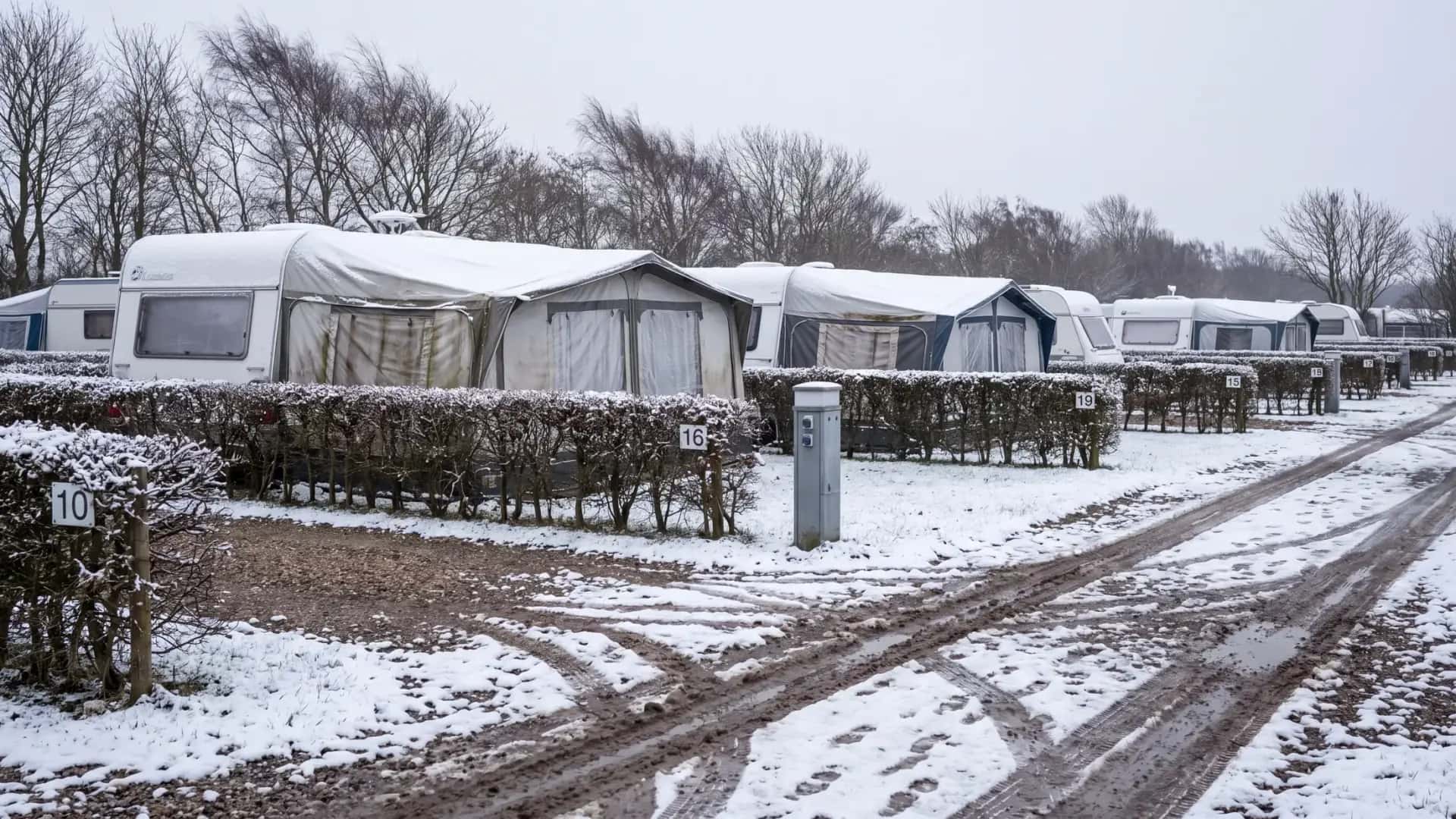
Open all year round
Winter Camping on the Baltic Sea
Fehmarn looks completely different in winter: empty beaches, clear air, and sunsets that come out stronger than in high summer. People who try it once tend to come back at the same time of year.
Several sites on the island do not close for the season. Heated sanitary buildings, electricity at the pitch, in some cases a sauna. Good for motorhome travellers who would rather have the Baltic without the crowds.
What actually matters in winter
Most winter camping guides start with the kit. That is the wrong order. People pitching up for the first time in winter rarely fail because a gadget is missing. They fail on three things: the gas runs out, the windows stream with condensation, and the water line freezes on the first cold night.
All three are solvable once you know about them. After that, winter camping is remarkably undramatic.
Gas: budget for far more than you expect
In summer an 11-kilo bottle lasts weeks. In winter it heats for roughly one week, and in sustained frost sometimes only five days. As a rule of thumb, reckon on about one kilo of gas a day once the heating runs continuously.
Two things follow. First: carry two bottles, not one. Running dry in the middle of the night is the classic. Second: find out in advance where you can swap a bottle nearby. Between Christmas and New Year many petrol stations and DIY stores keep short hours.
An automatic changeover regulator makes life easier. It switches to the second bottle by itself, and you only notice when you look at the indicator.
Condensation is the real problem
Four people release several litres of moisture into the air overnight, just by breathing. Add cooking, showering and wet jackets. That moisture has to go somewhere, and it settles on the coldest surface it can find: window frames, corners, the wall behind the seat cushions.
Heating and ventilating are not opposites, they belong together. Leaving the roof vent slightly open and keeping the forced ventilation clear costs less gas than people fear, because dry air warms up faster than damp air.
Laundry does not dry inside a caravan in winter. It hands all of its moisture to the interior. If the site has a drying room, use it.
- Pull cushions away from the outer wall so air can move behind them
- Air the van properly once each morning, five minutes is enough
- Wipe down windows and corners rather than waiting for mould
- Wet shoes and jackets go in the awning, not the living space
Water and waste water in frost
The fresh water hose outside freezes first, then the waste hose, then the waste tank. People who camp through winter therefore tend to work with canisters instead of a fixed connection, and drain waste water straight into a bucket that does not stay out overnight.
A heated waste tank helps but is not fitted to every vehicle. If you are unsure, leave the waste valve open at night with a bucket underneath. A frozen tank costs more than a full bucket.
Power: what 6, 10 and 16 amps mean
Site bollards are usually fused at 6 or 10 amps, less often 16. At 230 volts that works out at roughly 1,380, 2,300 and 3,680 watts. It sounds like plenty until a fan heater is running.
A typical fan heater draws 2,000 watts. That alone nearly exhausts a 10-amp supply, and the kettle then trips the breaker. If you plan to heat electrically, ask what the site is fused at and pick a heater with power settings.
Why the Baltic in winter is not the Alps in winter
Winter camping is almost always illustrated with snow and mountains. The Baltic coast looks nothing like that, and for many people that is the appeal. The sea acts as a heat store, so the coast rarely drops as deep into frost as inland areas. What it gets instead is wind, unobstructed.
In practice: you need less frost protection than in the mountains and more wind protection. A properly guyed awning matters more on the coast than an extra insulating mat under the floor. And you want to know which way the wind is coming from before you position yourself.
The second difference is the emptiness. A Baltic beach in January is effectively yours alone. Anyone who has walked an empty shoreline at five degrees and full sun understands why some people travel in winter specifically for this.
What there is to do on the coast in winter
The honest answer: less than in summer, and that is the point. The days are short and so is the programme. A long walk on the beach, lunch somewhere warm, a sauna or thermal bath in the afternoon, an early evening indoors.
When it blows, the surf against a cliff coast is a spectacle in itself. On Fehmarn the stretch at Katharinenhof is the best place for it. And bird migration takes no winter break: the coastal roosting grounds stay busy from autumn through to spring.
What "open all year" really means
Open all year does not mean everything is open. Many sites run a reduced operation in winter: one sanitary building heated, the rest closed. The shop keeps short hours, the restaurant maybe opens at weekends only. Some sites listed as year-round take a short break between early January and Easter.
When in doubt, phone. A two-minute call answers what no website says: whether the sanitary facilities are heated, whether there is water at the pitch, and whether anyone else will be there in January.
Frequently asked questions
- What do I need to know about winter camping?
- The three things people most often get caught out by are gas supply, condensation and freezing water. Reckon on about a kilo of gas per day and carry a second bottle. Ventilate daily despite the heating, otherwise moisture settles on windows and in corners. And in frost, work with canisters rather than permanently connected hoses.
- How cold does it get camping on the Baltic in winter?
- Considerably less cold than inland or in the uplands. The sea stores heat and buffers the extremes, so several days of continuous frost are the exception on the coast. The wind is stronger though, which means it usually feels colder than the thermometer suggests.
- Do I need a special caravan for winter camping?
- No, but it makes a difference. Winterised vehicles have better insulation, heated waste tanks and warm air ducts in the floor. A standard caravan works too if you heat more, ventilate consistently and handle water via canisters.
- How much electricity do I need on a campsite in winter?
- It depends on whether you heat electrically. Without a fan heater a 6-amp supply is enough, roughly 1,380 watts. A typical fan heater alone draws 2,000 watts and needs at least 10 amps. Ask about the fusing before you book.
- When is winter camping on the Baltic at its best?
- Between late October and early March. The clearest days usually fall in late autumn and in February, when the air is dry and visibility is long. The week between Christmas and New Year is busiest; in January you have the beaches essentially to yourself.
17 campsites on one island
Every site on Fehmarn has its own character. Browse through all of them and find the one that fits.
See all campsites on Fehmarn