
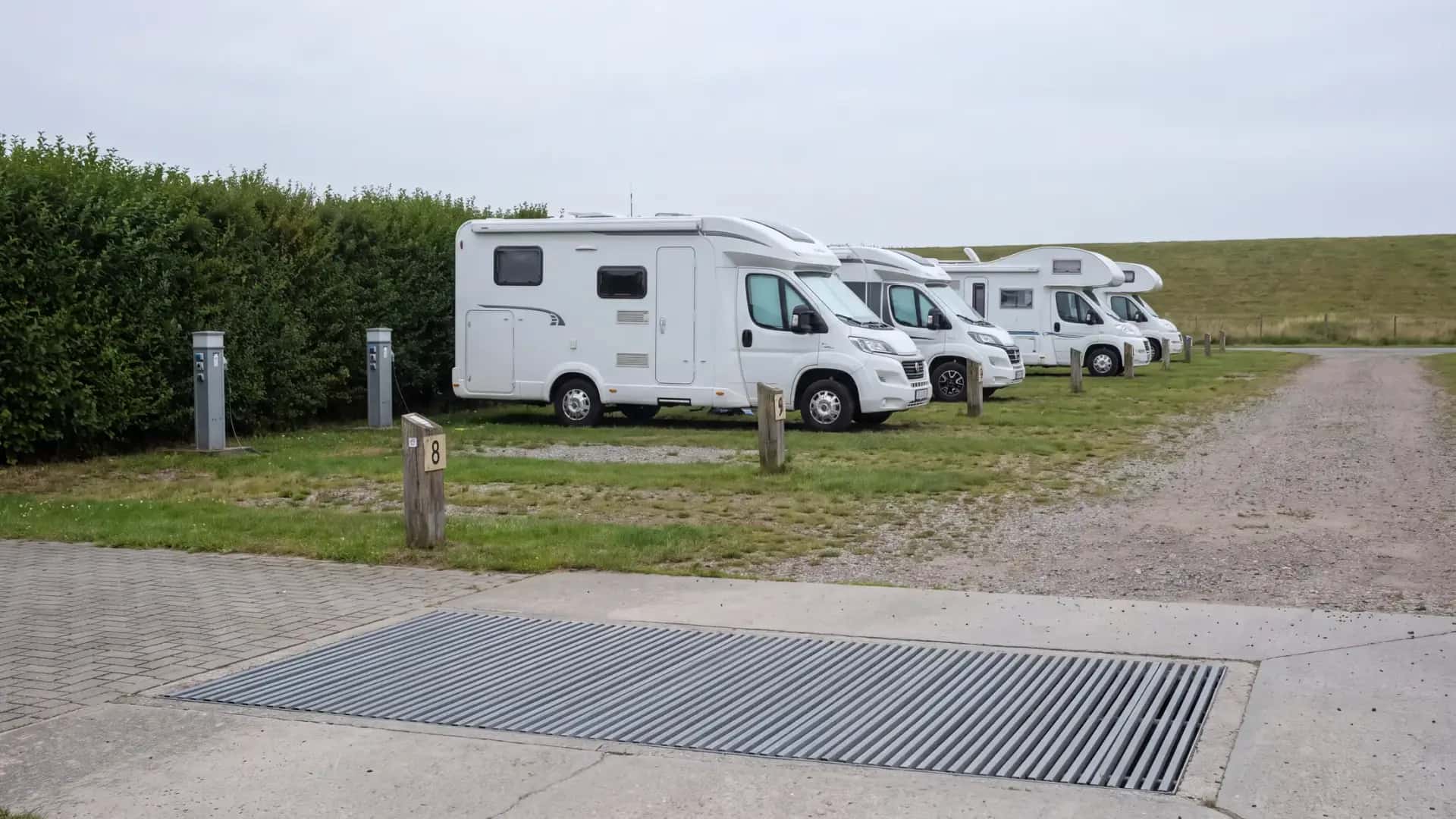
Supply & disposal
Motorhome Pitches on the Baltic Sea
In a motorhome you decide in the morning where you will stand that evening. Fehmarn is well set up for it.
Many sites have generous pitches with electricity, water and wastewater connections, plus supply and disposal stations. Some stay open through the winter.
Motorhome pitch or campsite?
The two terms get used interchangeably but mean different things. A motorhome pitch, or Stellplatz, is for overnighting. You stand on a marked bay, you have power and a service point, and in the morning you drive on. Tables, chairs and awnings do not formally belong there.
A campsite is for staying. You get a pitch, you are allowed to spread out, and there are sanitary buildings, often a shop and sometimes a restaurant. You pay more and you are less flexible, because in season you have to book.
The line is blurring, because many campsites now run a separate motorhome area with its own access. For travellers that is often the best of both: short stays like a Stellplatz, infrastructure like a campsite.
How the service point works
The station has three parts that have nothing to do with each other but get confused regularly. Fresh water comes from a tap marked as drinking water. Grey water, meaning waste from sink and shower, drains through a floor gully you drive the vehicle over. The toilet cassette is emptied at a separate disposal point.
The mistake you make once and never again: rinsing the cassette at the fresh water tap. There is a dedicated rinse fitting for that. At well-designed stations the three areas are physically separated; at poor ones they sit side by side.
In high season expect a queue in the morning. Between eight and ten everyone wants to empty and leave at once. Emptying the evening before saves you the wait.
Power: what the amp rating means
Pitches are usually fused at 6, 10 or 16 amps. At 230 volts that is roughly 1,380, 2,300 and 3,680 watts. The figure is yours alone and not shared, but it caps everything running at once.
In practice it gets tight as soon as a heater joins in. A 1,800-watt kettle and a 2,000-watt fan heater together will blow any 10-amp supply. If you run a lot electrically, ask what the site is fused at beforehand.
A CEE adapter belongs in the vehicle, along with an extension of at least 25 metres. The bollard is not always where you expect it, and a cable that is too short sometimes decides which pitch you get.
What a coastal site has to handle
On the Baltic there are demands that do not arise inland. The main one is wind. A pitch open to the sea has the better view and the more restless nights. Anyone who has tried to retract an awning in a force seven pays attention to hedges and banks next time.
The second is the ground. Grass areas immediately behind the dike flood quickly after heavy rain, and a heavy vehicle digs itself in. Gravel or reinforced grass is unglamorous and dependable.
The third is salt. Salt-laden air attacks aluminium, screws and bicycle chains faster than people expect. If you stay on the coast for a while, rinse the bikes before the drive home.
Wild camping on the Baltic: what is actually allowed
The legal position is clearer than online forums suggest. In Germany you may spend one night on public parking areas in order to restore your fitness to drive, provided it is not signposted otherwise. That is permission to sleep, not permission to camp.
The moment chairs, a table, an awning or a barbecue appear outside, it stops being overnighting and becomes camping, which is not permitted outside designated sites. Coastal municipalities do check, in places very consistently, because motorhome pressure has risen sharply in recent years.
Many communities on both the Baltic and North Sea coasts have put up prohibition signs anyway. The pragmatic route is the official pitch. It generally costs a low double-digit sum per night, usually including service, and you sleep without waiting for a knock.
Fehmarn as a base
For motorhome travellers the island has one practical quality: it is small enough that you reach everything from any base, and large enough that several bases are worth it. From the northern tip to the south coast is around 20 kilometres. Wanting to be on the east side in a westerly costs you half an hour.
Access is straightforward, because the Fehmarnsundbrücke connects the island directly to the A1 motorway. No ferry, no waiting time and no height restriction that matters for a motorhome.
Several sites on the island run their own motorhome area with a service point, in some cases with power and water at the individual bay. Part of that capacity stays open all year, which makes Fehmarn one of the more dependable destinations on the German Baltic coast outside the season.
Book ahead or take your chances
Driving to the Baltic coast between mid-June and late August without a reservation works, but it costs nerves. Popular sites are full by early afternoon, and arriving at six means searching.
Outside those weeks the opposite applies. In May, September and October you will find a pitch almost anywhere, often at lower rates, and the wind sits better for anyone heading onto the water.
Frequently asked questions
- What is the difference between a Stellplatz and a campsite?
- A motorhome pitch is intended for overnighting: a marked bay, power, a service point and a short stay. A campsite is intended for staying, with your own pitch, sanitary buildings and permission to spread out with table, chairs and awning.
- Can you wild camp with a motorhome on the Baltic?
- One night on a public parking area is permitted where it is not expressly prohibited and where you are only restoring your fitness to drive. As soon as chairs, a table or an awning are outside, it counts as camping and is not permitted outside designated sites. Many coastal municipalities enforce this.
- What does a motorhome pitch on the Baltic cost?
- A low double-digit sum per night is typical, usually including the service point. Electricity is often billed separately, either as a flat rate or by meter. High season rates are noticeably above those in spring and autumn.
- How much power do I need at a motorhome pitch?
- For fridge, lighting and charging, a 6-amp supply at roughly 1,380 watts is enough. As soon as a fan heater or kettle joins in you need 10 or better 16 amps. A CEE adapter and a cable of at least 25 metres belong in the vehicle.
- How does the service point work?
- Fresh water comes from a tap marked as drinking water. Grey water from sink and shower drains through a floor gully you drive over. The toilet cassette is emptied at a separate disposal point and rinsed there, never at the fresh water tap.
17 campsites on one island
Every site on Fehmarn has its own character. Browse through all of them and find the one that fits.
See all campsites on Fehmarn